Tronc and the UK tipping law
The UK tipping law already applies. Since 1 October 2024 an employer must pass qualifying tips, gratuities and service charges to workers, without a deduction for the house, and must allocate them fairly. A tronc is one way to do that allocation. It does not switch the Employment (Allocation of Tips) Act 2023 off. A written policy and a three-year record are required where tips are more than occasional.
A tronc is a pooled fund of tips. The tipping law is the rule for that money. Since 1 October 2024 hospitality employers have had to follow the Employment (Allocation of Tips) Act 2023 and the statutory code of practice issued under it. This page says what is in force. It does not invent a percentage of sales that ought to be tips.
The short answer
Pass qualifying tips on to the workers. Do not keep a share for the business. Allocate the total fairly at that place of business, have regard to the code, and pay by the end of the following month. If tips are part of ordinary service, keep a written policy and a record for three years. A tronc can be how you allocate. It is not a way out of the Act.
The Act extends to England and Wales and Scotland. This page does not state a Northern Ireland tipping code.
The rule in detail
The text is legislation.gov.uk, Employment (Allocation of Tips) Act 2023. The code is GOV.UK, code of practice on fair and transparent distribution of tips. Both took effect on 1 October 2024.
Qualifying tips
Card or cash does not decide it. The code says the method of payment is not what makes a tip qualifying. What matters is whether the employer receives the tip, or controls or significantly influences the split.
A card tip that lands with the employer is employer-received. A cash tip the worker keeps, with no instruction and no collection by you, is outside the Act. If you collect the jar, or tell staff how to split cash, that is control. A service charge you receive follows the same rules. A tip that never comes through you is outside the code.
Passing the money on
Qualifying tips must be passed on without deductions, except in very limited cases. The code gives income tax as the example. A cut for breakages, card fees or the business is not that exception.
Pay by the end of the month after the month the customer paid. The code's example is a tip left on 23 June, which must be distributed by 31 July.
The total at that place of business must be allocated fairly between workers there. Fair does not mean identical shares. The code allows different proportions for a legitimate reason, and it says agency workers and zero-hours workers on that site have to be considered. For an agency worker, the hirer is the employer for this purpose. Once the hirer pays the agency, the agency must pass the sum on without an unauthorised deduction.
A written policy and the record
You need a written policy when qualifying tips are paid at the place on more than an occasional and exceptional basis. The code's example of a business that may not need one is a clothing shop that receives tips only a few times a year. A cafe, pub or restaurant that takes tips in ordinary service does need one.
Say how tips are accepted and shared. Use plain language, give every worker the same access, including an agency worker on a short booking, and provide an accessible format if a disabled worker asks.
The record shows the qualifying tips received at that place and the amount allocated to each worker. Keep it for three years from the date the tip was paid. A worker may make one written request in any three-month period, for a stretch they worked the whole of, going back up to three years. You give them the total and their own amount, not colleagues' amounts. The tips code points employers to the Acas code of practice on disciplinary and grievance procedures when someone queries a share.
An independent tronc
Section 27F lets an independent tronc operator allocate some or all of the tips. That person might be a member of staff, someone the workers agree, or an external firm. You must reasonably consider that they act independently, and the framework you set must be fair. If you later learn the split is unfair, change the instructions, replace the operator, or end the tronc.
Tax is separate. GOV.UK, tips, gratuities, service charges and troncs is the HMRC page. This page does not decide National Insurance or PAYE. Shiftbrook does not calculate either.
Exceptions
A kept cash tip, with no employer control, is outside the Act. So is a tip that never reaches the employer. A workplace that receives tips only occasionally can sit outside the written-policy duty. A jar a supervisor splits at the end of the night is not that narrow case.
Tips do not count towards the national minimum wage. The code says they are not basic pay. The rates are on the minimum wage guide and GOV.UK, national minimum wage rates. A rate below the age band, with tips promised on top, does not meet the wage.
GOV.UK's implementation timeline lists a further strengthening of tipping law on 1 January 2027, and says dates may still change. That line does not remove the duties in force since 1 October 2024. This page will not guess what it adds.
Worked example
Copy the code's deadline: a tip paid on 23 June must reach the workers by 31 July.
This sum is an illustration, not a claim about what a cafe takes. Suppose June's card tips at one site are £400, and the written policy shares them by hours there. Alex worked 80 hours and Sam worked 120 hours, so the shares are £160 and £240. Income tax may still be taken through PAYE. Nothing is held back for the house. Hours are one method you may choose, not the only fair one. The hours come from the week you published. How to rota a small cafe or pub is that week. A paper file is the timesheet template. It adds up hours. It does not split a tip.
A checklist
- You know which tips qualify, including card tips and service charges you receive.
- The qualifying amount is passed on, apart from a deduction the law allows, such as income tax.
- Payment is no later than the end of the following month.
- The written policy exists if tips are more than occasional, and agency workers can read it.
- Any tronc operator is independent, and you would act if the split became unfair.
- The record has the total and each worker's amount, for three years, and tips are not used to meet the minimum wage.
What this means for your rota
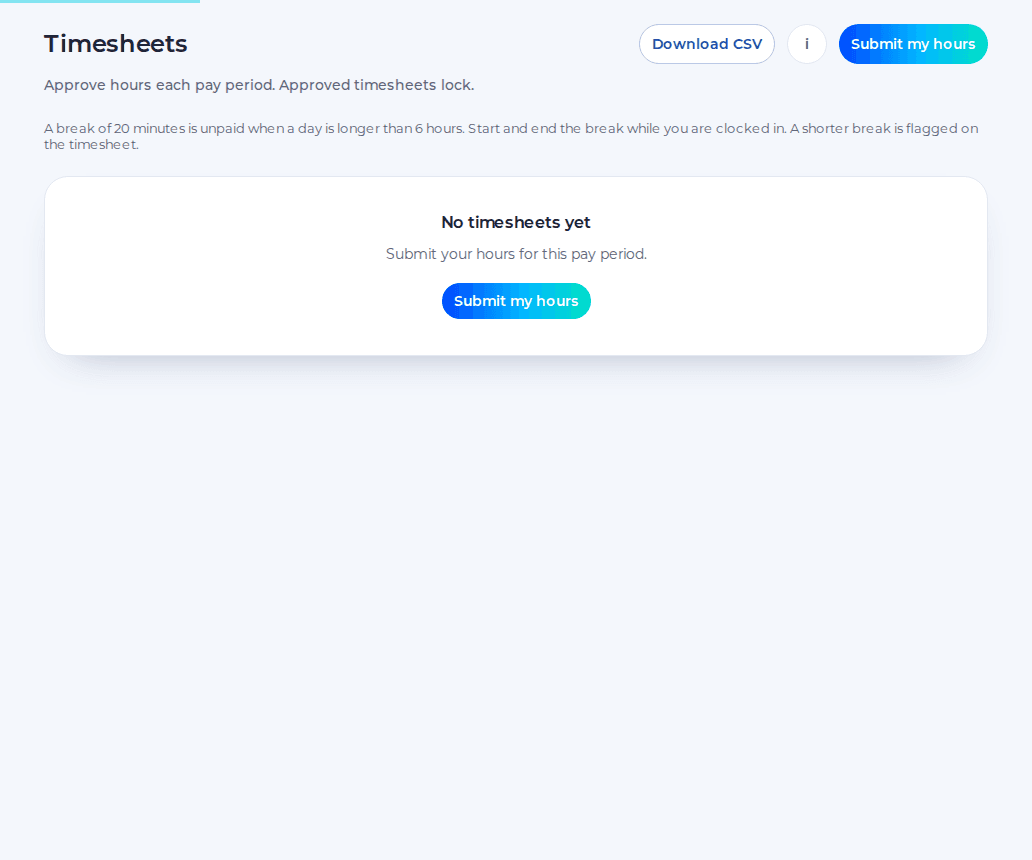
Hospitality scheduling software is the opens, the closes and the hours you approve. It is not a tronc. Those hours can show who was working when you apply a written rule yourself. Timesheets are where the hours are submitted, approved and downloaded. The first organisation is free for up to 5 staff. The paid plan is £3 per user per month, with a £15 minimum. You can use the paid plan for 14 days before the first payment, and that period does not ask for a card. Shiftbrook does not allocate tips, store a tipping policy, or calculate pay or tax.
Questions
Do I have to pass on every tip?
Not a cash tip a worker receives and keeps, with no employer control. Qualifying tips, including most card tips and a service charge the employer receives, must be passed on without a deduction for the house. Income tax can still be deducted. The code of practice has applied since 1 October 2024.
Does a tronc replace the tipping law?
No. A tronc is one way to allocate qualifying tips. An independent tronc counts as a fair allocation only where the arrangement is fair and the operator is independent of the employer. If the employer later learns the tronc is unfair, they have to act.
When do I need a written tipping policy?
When qualifying tips are paid at the place of business on more than an occasional and exceptional basis. A cafe that takes tips in ordinary service needs the policy. A shop that receives a tip a few times a year may not. Workers, including agency workers, must be able to read it.
Do tips count towards the minimum wage?
No. Tips do not count towards the national minimum wage. Paying a lower hourly rate and making it up with tips is not lawful. The rates are on the minimum wage guide.
Sources
legislation.gov.uk, Employment (Allocation of Tips) Act 2023 is the Act. GOV.UK, code of practice on fair and transparent distribution of tips is the statutory code, in force from 1 October 2024. GOV.UK, tips, gratuities, service charges and troncs is the HMRC guidance. GOV.UK, national minimum wage rates is the wage tips cannot be used to meet. Checked on 26 October 2026.
Related
The first organisation is free for up to 5 staff. The paid plan is £3 per user per month, with a £15 minimum. You can use the paid plan for 14 days before the first payment, and that period does not ask for a card. An agency pays £5 per active worker per month, with a £25 minimum. Client approvers are free and do not count.
Start free Log inGeneral guidance for UK employers, not legal advice.